






When Is the Best Time to Take Magnesium? A Guide to Timing Your Supplement


Trying to find the best time to take magnesium can be a frustrating experience. Some sources recommend taking it in the morning for energy, while others insist on an evening dose for sleep. This conflicting advice often leaves people feeling uncertain about how to get the most from their supplement.
The truth is, there isn't a single "best time" that applies to everyone. The optimal timing depends on your personal health goals, the type of magnesium you are taking, and how your own body responds.
This article is designed to move beyond simplistic rules. We will walk through how healthcare professionals approach this question, focusing on a framework that helps you match your magnesium timing to your specific needs. The goal is to replace confusion with a clear, logical strategy.
Understanding How Your Body Uses Magnesium

To determine the best time to take magnesium, it helps to understand how the body absorbs and utilises this essential mineral. Magnesium absorption is not a passive process; it is an active one influenced by your digestive system and your body’s internal 24-hour clock, known as the circadian rhythm.
These interactions are why timing can make a noticeable difference. For example, stomach acid levels naturally fluctuate throughout the day, often peaking during meals to aid digestion. This acidic environment can be important for the proper breakdown and absorption of certain forms of magnesium.
Key Factors That Influence Absorption
When you take a magnesium supplement, it travels through your digestive tract, where it must be broken down and then absorbed through the intestinal wall into your bloodstream. This process can be affected by several factors.
- Your primary health goals: Are you aiming to improve sleep, support daytime energy, or aid digestive regularity?
- The form of magnesium: Different types, such as glycinate or citrate, have distinct effects and are often better suited for specific times. You can explore various types of magnesium supplements to understand these differences.
- Competition with other minerals: Magnesium and calcium compete for absorption. Taking large doses of both at the same time may reduce the effectiveness of each. Spacing them apart by a few hours is a common strategy.
- The impact of food: High-fibre meals can sometimes bind to magnesium, slightly reducing its absorption. However, taking magnesium with food is often recommended to prevent stomach upset, a common side effect of forms like magnesium oxide or citrate.
In clinical settings, the focus often shifts from finding a single "perfect" time to identifying the "most effective" time for an individual's needs. Consistency and matching the right form to the right goal are generally more important than the exact hour on the clock.
By understanding these core principles, you can begin to build a routine that aligns with your body and your wellness goals, rather than following generic advice that may not be right for you.
Timing Magnesium for Sleep and Relaxation

If your goal is to improve sleep quality or manage feelings of stress, taking magnesium in the evening is a logical approach. This timing is based on magnesium's role in supporting the nervous system's ability to wind down.
Magnesium interacts with a neurotransmitter known as GABA (gamma-aminobutyric acid), which helps calm nerve activity. By supporting GABA function, magnesium can help quiet the mind and prepare the body for rest, making it easier to fall asleep.
Why an Evening Dose Is Often Effective
Taking a magnesium supplement approximately one to two hours before bedtime allows sufficient time for absorption and for its calming effects to begin. This timing aligns with the body's natural circadian rhythm, supporting the production of melatonin, the hormone that signals it is time to sleep. An evening dose may also help alleviate restless legs or muscle cramps that can disrupt sleep.
For sleep and relaxation, certain forms of magnesium tend to be more suitable.
-
Magnesium Glycinate: This is a frequently recommended form for evening use. Magnesium is bound to the amino acid glycine, which itself has calming properties. It is also known for being gentle on the digestive system, which is ideal before bed. For more detail, this resource on Magnesium Glycinate for sleep can be helpful.
-
Magnesium L-Threonate: This form is noted for its ability to cross the blood-brain barrier, potentially offering more direct support for brain relaxation and cognitive calming.
Forms like magnesium citrate or oxide are sometimes less ideal at night, as they can have a laxative effect in some individuals. You can explore the specific benefits of magnesium glycinate here.
From a clinical perspective, recommending a form like magnesium glycinate in the evening is a common strategy. It addresses both mental and physical aspects of restlessness without typically causing digestive distress. The aim is to gently support the body's natural relaxation processes, not to act as a sedative.
By taking magnesium between 7 PM and 9 PM, you may set the stage for more restorative sleep. This is particularly relevant as poor sleep can exacerbate other health issues. By matching your supplement timing to your body’s needs and choosing a form suited for relaxation, you create better conditions for a restful night.
Timing Magnesium for Daytime Energy and Muscle Function
While magnesium is well-known as a relaxation aid, taking it in the morning can be an effective strategy for supporting energy levels, mental focus, and muscle function throughout the day. This is grounded in magnesium's fundamental role in cellular energy production. It is a necessary cofactor for over 300 enzymatic reactions in the body, many of which are involved in converting food into usable energy.
Taking magnesium with breakfast can be thought of as supporting your body’s metabolic processes at the start of the day. This can contribute to a more stable release of energy, potentially helping you feel more alert and less fatigued.
Supporting the Body’s Daily Rhythms
A morning dose can also work in harmony with the body's natural hormonal cycles. Cortisol, often called the "stress hormone," naturally peaks in the morning to promote wakefulness. Magnesium helps regulate the body’s stress response system, ensuring that nerve and muscle function is properly supported from the start of the day. For those who are physically active, this can be particularly beneficial for both performance and recovery.
In clinical settings, a morning dose of magnesium is often suggested for individuals reporting daytime fatigue or "brain fog." The principle is straightforward: provide the body with a key nutrient for cellular energy production when the demand is highest.
Choosing the Right Form of Magnesium for Morning Use
The type of magnesium you choose is just as important as the timing. For daytime use, it is generally best to select a form that is less likely to have a strong relaxing effect.
- Magnesium Malate: This form is bound to malic acid, a compound involved in the body's primary energy production pathway (the Krebs cycle). This makes it a popular choice for addressing fatigue and muscle soreness.
- Magnesium Citrate: This is a well-absorbed form that also plays a role in energy metabolism. It may have a gentle laxative effect, which can be helpful for those seeking digestive support. You can learn more about its interaction with other minerals in the guide on Potassium Magnesium Citrate.
Of course, if sleep is the primary concern, the timing advice differs, as illustrated in this simple flowchart.
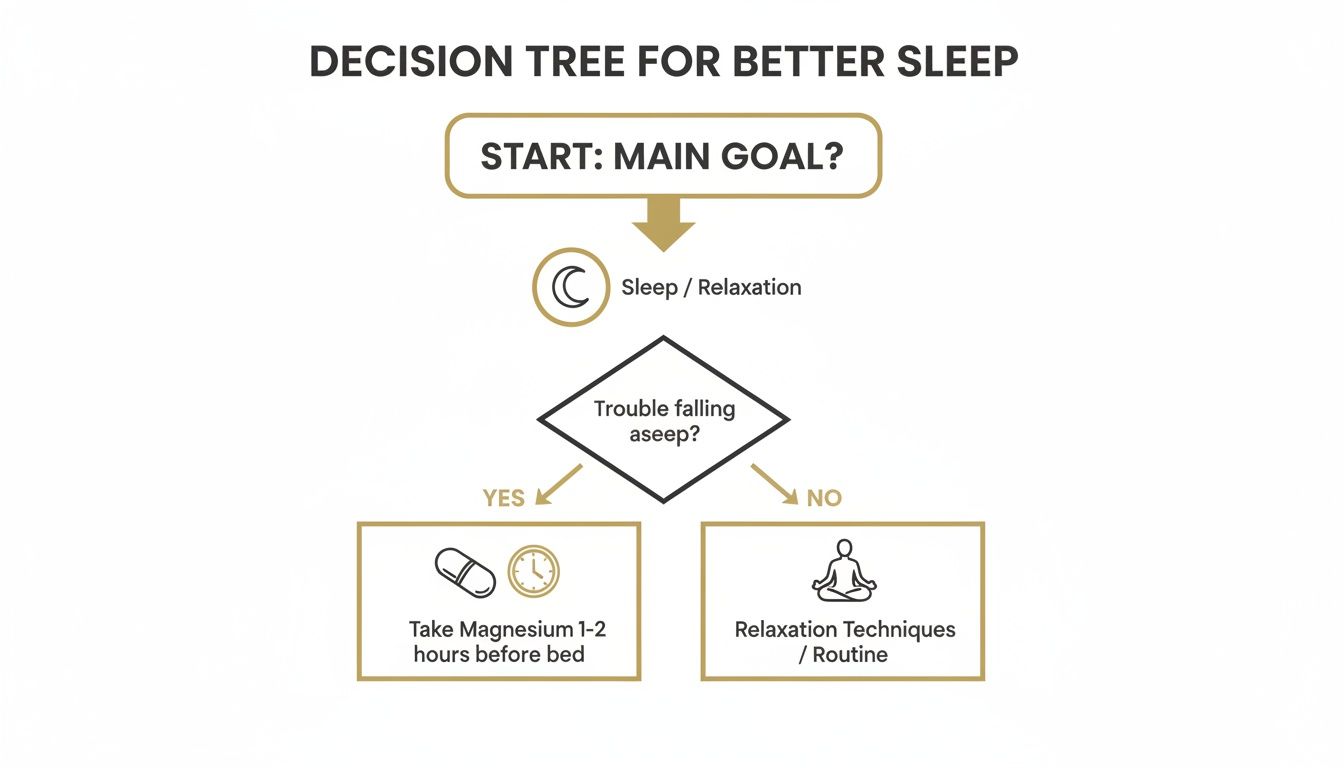
For morning energy, taking your supplement approximately 30 minutes before breakfast may be beneficial. Higher levels of stomach acid present at this time can enhance the bioavailability of certain forms. For a broader context on how this mineral supports vitality, it may be useful to explore information on magnesium for energy alongside other nutrients.
The table below provides a quick summary to help you align your magnesium schedule with your health goals.
Matching Magnesium Timing to Your Health Goal
| Health Goal | Recommended Timing | Reasoning | Suggested Magnesium Form |
|---|---|---|---|
| Daytime Energy | Morning, with breakfast | Supports metabolism and aligns with the body's natural energy cycles. | Malate, Citrate |
| Better Sleep | 1-2 hours before bed | Promotes relaxation by supporting GABA and melatonin production. | Glycinate, L-Threonate |
| Exercise Support | 1 hour before workout | Aids muscle function, energy production, and electrolyte balance. | Malate, Orotate |
| Stress Management | Evening or split dose | Helps regulate cortisol and calm the nervous system. | Glycinate, L-Threonate |
This table can serve as a starting point. The most important step is to observe your own body's response and adjust as needed.
A Practical Approach to Finding Your Best Time

Ultimately, the best time to take magnesium is the time that you can maintain consistently. The goal is not to find a single perfect window, but to develop a routine that reliably delivers the benefits you are seeking.
This process involves thoughtful observation rather than guesswork. By following a structured approach, you can move past generic advice and identify a schedule tailored to your own biology.
Start with Your Primary Goal
The most logical first step is to align your timing with your main reason for taking magnesium.
- For improved sleep: Begin by taking your supplement one to two hours before bed.
- For daytime energy: Start with a morning dose, taken with breakfast.
- For digestive support: A morning dose of a form like magnesium citrate is a common starting point.
This initial decision is not permanent. It is simply a hypothesis from which you can observe and make adjustments.
Begin with a Low Dose and Be Patient
When starting any new supplement, it is wise to begin with a lower dose to assess your body's tolerance. This is particularly true for magnesium, as higher doses can sometimes cause digestive upset.
Once you have established your starting time and dose, consistency is the most critical factor. It can take several weeks for magnesium levels to normalise in your system and for noticeable benefits to emerge. It is important to resist making frequent changes to your routine during this initial period.
In clinical practice, patients are often reminded that supplementation is a gradual process. The objective is to gently support the body over time, not to achieve an overnight fix. Patience allows you to observe the true effects of a consistent routine.
Keep a Simple Journal
To track your progress objectively, consider keeping a simple daily journal. This does not need to be complex; a few notes in a notebook or on your phone will suffice. This practice is often discussed in our other articles on nutrition.
Each day, briefly note your observations regarding:
- Your primary goal: Are you sleeping more soundly? Do you have more sustained energy?
- Digestive comfort: Note any bloating, cramping, or changes in bowel habits.
- Energy levels: How do you feel in the morning, afternoon, and evening?
After two to three weeks, review your notes. This record provides clear feedback, helping you decide whether to maintain your current routine or make a small adjustment. This methodical approach allows you to find what works best for your body.
Common Questions About Magnesium Timing
Even with a clear plan, questions can arise when starting a new supplement. Here are answers to some of the most common queries.
Should magnesium be taken with or without food?
For most people, taking magnesium with a meal or a small snack is recommended. This can significantly reduce the likelihood of stomach upset, which can occur with certain forms on an empty stomach. Taking it with food may also slightly improve absorption.
Is it okay to split the magnesium dose?
Yes, splitting your dose is an excellent strategy, particularly if you are sensitive to its effects on your digestive system. Taking a smaller amount in the morning and another in the evening can help maintain more stable magnesium levels throughout the day. This often leads to better tolerance and absorption.
How soon will I notice a difference?
The benefits of magnesium supplementation are typically gradual. If you are taking it for sleep, look for patterns over several weeks rather than expecting an immediate change overnight. For energy, pay attention to your alertness levels over time. A simple journal is the most reliable way to track progress.
Does the type of magnesium affect the timing?
Yes, the form of magnesium is one of the most important factors in determining the best time to take magnesium. Forms known for their calming effects, such as Magnesium Glycinate, are generally best taken in the evening. In contrast, those involved in energy production, like Magnesium Malate, are often more effective when taken in the morning.
At The Patients Guide, we focus on providing clear, in-depth information to help you manage your health with confidence. If this article helped reduce confusion, you may find our structured health guides offer a deeper level of understanding. They are created for those who want to go beyond articles and connect concepts for long-term clarity.
You can explore our full library of step-by-step guides at https://www.thepatientsguide.co.uk.
Also in News


Understanding Brain Fog Symptoms and Finding Clarity
A calm, clear guide to understanding brain fog symptoms. Learn the common signs, potential causes, and practical next steps for managing mental fatigue.
Read More


Exercises for Neck Pain Relief: A Calm, Measured Approach
A calm, structured guide to gentle exercises for neck pain relief. Learn safe, effective stretches and movements to manage discomfort and improve neck health.
Read More


Post Concussion Syndrome Treatment: A Practical Guide to Recovery
A clear guide to post concussion syndrome treatment. Understand persistent symptoms, proven therapies, and how to navigate a safe and active recovery.
Read More