






Exercises for Neck Pain Relief: A Calm, Measured Approach


Dealing with neck pain can be a frustrating and confusing experience. A search online often presents a mix of conflicting exercises—some promising instant relief, others appearing too aggressive for a neck that already hurts. This can leave you feeling uncertain about where to even begin.
This article is designed to offer a different perspective. We will move away from isolated tips and focus instead on the principles healthcare professionals use when approaching neck pain. The aim is to help you understand the context of your symptoms and introduce gentle, controlled movements safely and effectively. This is not a list of quick fixes, but a framework for thoughtfully engaging with your recovery.
Understanding the Context of Neck Pain Before You Act
It’s tempting to jump straight into stretching when your neck feels stiff and sore. However, moving without first understanding the potential cause can sometimes aggravate the issue. Taking a moment to consider the patterns behind your discomfort is a more measured first step.
Neck pain is an incredibly common issue. In clinical settings, it’s one of the most frequent complaints, often linked to the demands of modern life. Sustained postures, such as those adopted while working at a computer or looking down at a phone, place consistent strain on the neck's supportive structures.
For many, neck pain isn't the result of a single dramatic injury, but rather the cumulative effect of daily habits. Acknowledging this can shift the focus from seeking a miracle cure to building more sustainable, supportive routines.
Common Patterns Behind Neck Strain
Thinking about neck pain as a symptom with underlying causes, rather than a standalone problem, is often more productive. When clinicians assess neck pain, they typically look for a few common patterns. Recognizing which of these might apply to you can help make your approach to exercise more targeted.
Commonly seen patterns include:
- Sustained Forward Head Posture: When the head drifts forward, out of line with the shoulders, the muscles at the back of the neck must work much harder to support its weight. This is a frequent contributor to muscular fatigue and strain, often referred to as ‘tech neck’.
- Muscle Imbalances: Over time, certain postures can lead to predictable imbalances. Muscles at the front of the neck (deep neck flexors) may become underused and weak, while muscles across the upper back and shoulders (upper trapezius) become chronically tight and overworked.
- Reduced General Movement: A sedentary lifestyle can lead to general stiffness in the cervical spine. Without regular, gentle movement through its full range of motion, the joints and soft tissues can become less mobile and more prone to discomfort.
- Acute Strain: Sometimes, a specific event like sleeping in an awkward position or a sudden movement can cause a temporary, acute muscle strain. You can learn more about these mechanics in our guide to understanding neck strain.
The exercises in this guide are designed to gently counteract these common patterns. The focus is on restoring mobility and building foundational support, which are key principles for long-term neck health.
Foundational Movements to Restore Gentle Mobility
When a neck is painful and stiff, the instinct is often to force a deep stretch into the area. However, in clinical practice, the initial focus is almost always on restoring gentle, controlled movement first. The goal is to calm the nervous system and encourage muscles to release tension, rather than trying to overpower them.
Stiff, guarded muscles are often a primary contributor to limited movement and persistent discomfort. Before effective strengthening can occur, a foundation of mobility is usually necessary. This initial step helps prepare the neck for more active work and can reduce the risk of a flare-up.
As you move through the following exercises, the emphasis should be on slow, deliberate, and mindful motion. Pay close attention to the feedback your body provides. If any movement triggers sharp or radiating pain, it’s important to ease back.
Targeting Key Muscles with Care
Two muscle groups commonly involved in neck pain patterns are the upper trapezius and the levator scapulae. These muscles run from the neck and base of the skull down toward the shoulder blades and are frequently overworked, particularly with prolonged screen time.
Gentle, sustained stretches for these areas can provide significant relief. The key is consistency and performing them correctly, without forcing the movement.
This infographic provides a simple visual of how we move from an initial strain, to experiencing symptoms, and finally, toward relief through restorative action.
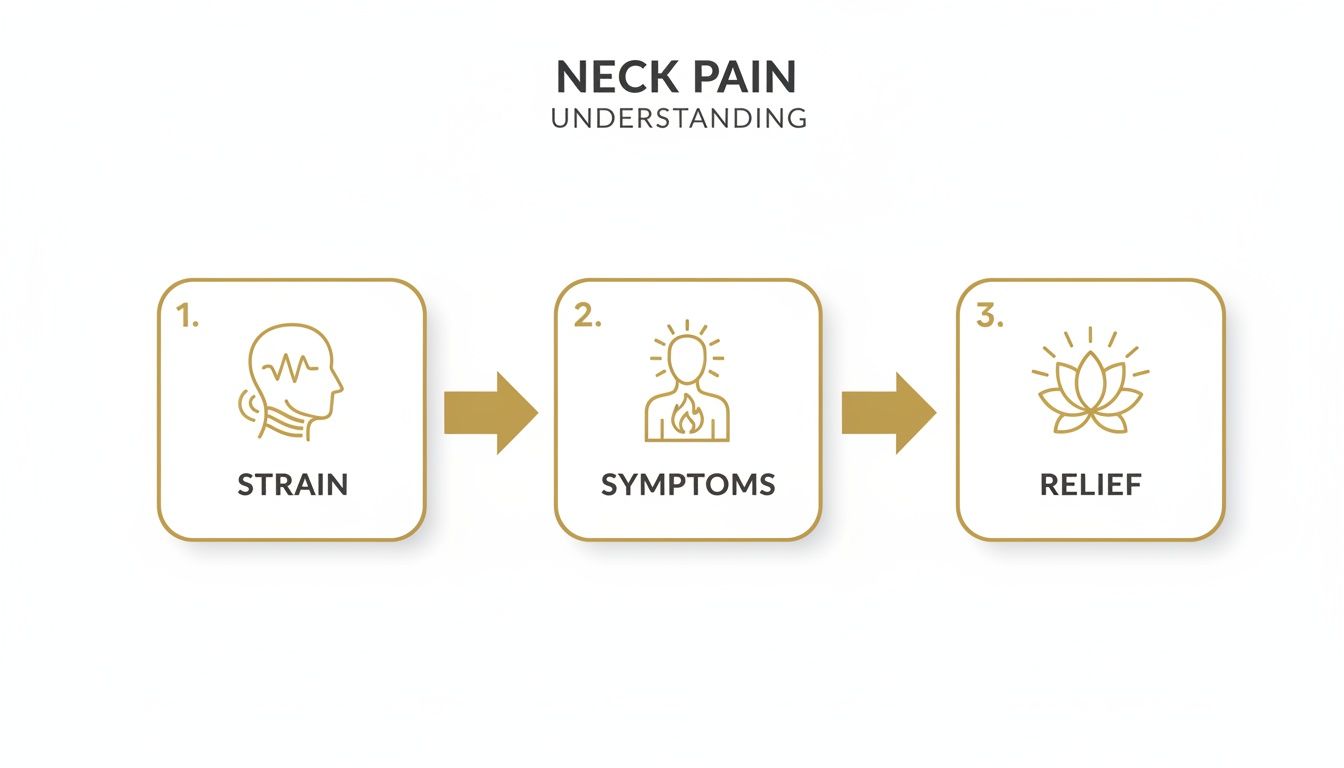
This illustrates that relief is a process, not a single event. It often begins with these gentle, foundational movements.
Chronic pain is a significant public health issue. According to the government's Chronic Pain Report, a large percentage of the population deals with persistent pain, with neck and shoulder pain being very common. This underscores the need for safe, sustainable self-management strategies.
Here is a simple routine to begin with.
Gentle Mobility and Stretching Routine
This table outlines foundational exercises that focus on gentle movement and releasing tension. Remember to perform each one slowly and without force.
| Exercise | Primary Target Area | Instructions | Recommended Hold/Reps |
|---|---|---|---|
| Upper Trapezius Stretch | Side of the neck (Upper Trapezius muscle) | Sitting tall, gently tilt your right ear towards your right shoulder. For a deeper stretch, you may rest your right hand on your head, allowing its weight to add gentle pressure without pulling. | Hold for 20–30 seconds each side |
| Levator Scapulae Stretch | Back corner of the neck (Levator Scapulae) | From a seated position, turn your head about 45 degrees to the right. Gently nod your chin down towards your collarbone until you feel a stretch along the back-left side of your neck. | Hold for 20–30 seconds each side |
| Head Nods (Chin Tucks) | Deep neck flexors, base of the skull | Lying on your back, gently tuck your chin towards your chest to create a "double chin" effect. Focus on lengthening the back of the neck without lifting your head from the surface. | 10 slow repetitions |
| Head Rotations | Overall neck mobility | Sit or stand tall. Slowly turn your head to look over your right shoulder, moving only as far as is comfortable. Pause, then return to the centre and repeat on the left side. | 5 rotations to each side |
Breathing calmly and deeply during these movements can help relax the nervous system and allow the muscles to release.
The guiding principle is to always work within a pain-free range. The sensation should be one of a comfortable stretch or release, not a sharp warning signal. If you feel any significant pain, ease off immediately. These movements form the cornerstone of a safe neck care routine, helping to reduce stiffness and prepare your body for the next step: building supportive strength.
Building Support with Gentle Strengthening
While stretching can provide welcome, often immediate, relief from tightness, it is only one component of a comprehensive plan. For more lasting change, the focus often needs to shift toward gently strengthening the muscles that support the head and neck. Without this foundational support, relief gained from stretching may be temporary.
The head is a heavy structure. When the muscles designed to support it are not functioning optimally—particularly the deep neck flexors at the front and the postural muscles around the shoulder blades—the system can become unstable. This often forces other muscles, like the upper trapezius, to compensate and work overtime, leading to strain, tightness, and pain.

The goal of the following exercises is not to build bulk, but to improve the endurance and activation of these deep postural muscles. Doing so helps create a more stable, supportive system, which can reduce the daily strain on overworked tissues.
Precision Over Power
When strengthening the neck, the emphasis should always be on precision and control, not force. The objective is to activate the correct muscles. Pushing too hard or moving too quickly can easily aggravate sensitive tissues.
A common starting point in physical therapy is the chin tuck exercise. This is a subtle but powerful movement for engaging the deep neck flexors—muscles that are often underactive in individuals with chronic neck pain.
Another key exercise is the shoulder blade squeeze (scapular retraction). This targets the rhomboid and middle trapezius muscles in the upper back. Strengthening this area provides a stable base for the neck, helping to counteract the common forward-shoulder posture.
Introducing Isometric Exercises
If certain movements are currently too painful to perform, isometric exercises can be a valuable tool. An isometric contraction involves tensing a muscle without moving the associated joint. It is a safe way to begin building strength without causing irritation.
An isometric exercise uses gentle, static resistance. For example, you can place your palm on your forehead and gently press your head forward into your hand. Your hand provides just enough resistance to prevent any movement. You will feel the muscles at the front of your neck engage, but your head remains still.
This technique can help build strength and stability without placing stress on the joints themselves.
- Forward Resistance: Place your palm on your forehead. Gently press your head forward into your hand, holding the contraction for 5–10 seconds. Ensure your head does not move.
- Side Resistance: Place your right hand on the side of your head. Gently press into your hand, as if trying to bring your ear to your shoulder. Hold for 5–10 seconds, then repeat on the left side.
When performed consistently, these subtle strengthening exercises can build the muscular endurance needed to support your neck throughout the day, gradually reducing the burden on painful, overworked muscles.
Integrating Good Habits into Your Day
Performing specific neck exercises is an important step, but for lasting improvement, it’s helpful to consider the other 23 hours of the day. It’s easy to counteract the benefits of a 15-minute routine by falling back into postural habits that strain the neck for hours on end.
Think of your exercises as building resilience, and your daily posture as the environment where that resilience is tested.
One of the most common patterns seen in clinical practice is ‘forward head posture’, where the head sits forward of the shoulders. This position significantly increases the load on the muscles at the back of the neck. The aim isn’t to maintain a rigid, unnatural posture all day, but to cultivate an awareness that allows for more supportive and varied positions.

Small Adjustments Can Lead to Significant Relief
The key is to make posture a mindful awareness rather than a constant effort. It begins with gentle, consistent self-correction. A simple cue is to imagine a string gently lifting the crown of your head toward the ceiling. This thought alone often helps to lengthen the spine and bring the head back into a more neutral alignment.
Here are a few common scenarios where small changes can be impactful:
- At Your Desk: Position your monitor so the top third of the screen is at eye level. This simple ergonomic adjustment can prevent the neck from constantly craning downwards. Aim for elbows bent at roughly 90 degrees and allow your shoulders to relax away from your ears.
- On Your Phone: Instead of dropping your head to look down at your phone, consciously try to lift the device closer to eye level. This can feel awkward at first but dramatically reduces neck strain.
- While Sleeping: Your sleeping position should support the natural curve of your neck. For many, sleeping on their side or back is preferable to sleeping on their stomach, which can force the neck into a rotated position for long periods. A supportive pillow that fills the space between your neck and the mattress is essential.
Why This Awareness Matters
These postural habits are important because neck pain is a widespread issue. According to data on the epidemiology of neck pain, it has a high prevalence, with women being more commonly affected. These aches are often aggravated by daily activities and can sometimes be traced back to specific incidents. If symptoms began after an accident, for instance, our Whiplash Recovery Guide offers more structured support.
The goal isn't perfection, but awareness. Each time you notice a slumped posture and gently correct it, you are performing a micro-exercise that reinforces the work from your dedicated routine. This is how you build habits that can lead to real, lasting change, creating an environment where your neck has a chance to heal.
Building a Sustainable and Safe Routine
When it comes to managing neck pain, consistency is more important than intensity. A single, aggressive session is less effective than a simple, gentle routine performed regularly. The goal is to build a sustainable habit that supports your neck over the long term, not to find a quick, forceful fix.
A dedicated 10–15 minute session each day is an excellent starting point. By combining the mobility, stretching, and strengthening exercises we have discussed, you can create a balanced daily practice. This small commitment is more manageable and gives your body time to adapt without becoming overwhelmed or sore.
How to Progress Without Causing a Setback
Learning to listen to your body is perhaps the most important skill in this process. Progression involves gradually asking a little more of your neck muscles, but only when they are ready. Pushing too hard, too soon, is a common mistake that can lead to a flare-up.
Instead of jumping to more difficult exercises, consider progressing in more subtle ways:
- Increase Hold Duration: If a 20-second stretch feels comfortable, you might try holding it for 30 seconds.
- Increase Repetitions: Once 10 chin tucks feel easy and controlled, you could progress to 12 or 15.
- Increase Frequency: If one session a day feels good, you might add a short, two-minute mobility break in the middle of your workday.
A helpful guideline used in clinical settings is the "two-point rule." On a pain scale from 0 to 10, your pain should not increase by more than two points during an exercise. If your baseline pain is a 3/10, it should not go above a 5/10 during the movement. If it does, that is a sign to ease off.
When to Pause and Seek Professional Advice
While taking an active role in your recovery is beneficial, it is equally important to recognise when professional guidance is needed. Certain symptoms, often called 'red flags', may indicate that the issue is more than a simple muscle strain. These are clear signs to stop and consult a GP or a physiotherapist.
Paying attention to these warnings ensures you do not inadvertently worsen a more serious condition.
Be mindful of the following symptoms:
- Radiating Pain: Pain that travels from your neck down into your shoulder, arm, or hand.
- Numbness or Tingling: A persistent 'pins and needles' sensation in your arm or fingers.
- Weakness: Sudden or significant loss of strength in your arm or hand, such as difficulty gripping objects.
- Severe or Worsening Pain: Pain that is intense, does not improve with rest, or is getting progressively worse.
Understanding your limits is an empowering part of managing your health. It allows you to proceed with self-care safely, while also knowing when to seek an expert opinion.
To help structure your efforts, here is a sample schedule you can adapt to your own needs.
Sample Weekly Neck Care Schedule
| Day | Morning (5-10 mins) | Afternoon Break (2-3 mins) | Evening (5 mins) |
|---|---|---|---|
| Monday | Mobility Routine (all directions) | Chin Tucks & Shoulder Rolls | Gentle Stretches (Upper Traps) |
| Tuesday | Mobility & Strengthening (Chin Tucks) | Neck Rotations | Gentle Stretches (Levator Scap) |
| Wednesday | Mobility Routine (all directions) | Chin Tucks & Shoulder Rolls | Gentle Stretches (Upper Traps) |
| Thursday | Mobility & Strengthening (Scapular Retraction) | Neck Side Bends | Gentle Stretches (Levator Scap) |
| Friday | Mobility Routine (all directions) | Chin Tucks & Shoulder Rolls | Gentle Stretches (All) |
| Saturday | Mobility & Strengthening (both) | Active Rest (e.g., a short walk) | Rest or gentle stretches if needed |
| Sunday | Active Rest (focus on good posture during the day) | Active Rest | Rest |
This schedule incorporates variety and rest, ensuring you are not overworking the same tissues daily. The key is to find a rhythm that works for you.
Moving Beyond a Single Article
This article aimed to provide a clear, practical starting point for managing neck pain. The goal was to offer a safe, evidence-informed framework that cuts through some of the online noise.
We have covered several key concepts: the importance of restoring gentle movement before strengthening, the role of deep neck stabilising muscles, and the connection between daily posture and the pain cycle.
However, a single article can only provide an overview.
Lasting improvement often comes from connecting the dots—understanding not just what to do, but why your symptoms are occurring and how to address the root patterns. This deeper understanding is what empowers effective self-management.
While the exercises here are a solid foundation, some people find they benefit from a more structured, comprehensive plan. For those ready to explore their condition in greater detail, we have developed more in-depth resources.
Our collection of guides for neck-related conditions is designed to provide that broader picture, helping you build a coherent plan for your long-term neck health.
Your Questions on Neck Exercises Answered
Starting a new routine for neck pain often brings questions. Here are some answers to common concerns to help you proceed with clarity.
How Long Until My Neck Feels Better?
This is a very common question, and the answer varies from person to person.
Some individuals may feel a reduction in stiffness within a few days of consistent, gentle mobility work. For the more lasting changes that come from building strength and endurance, it is reasonable to expect a timeframe of four to six weeks of regular practice.
The key is consistency. If after several weeks of diligent effort your pain is worsening or not improving, it would be sensible to check in with a physiotherapist or your GP.
Should These Exercises Be Painful?
A feeling of a gentle stretch or the mild fatigue of a muscle being worked is normal. However, you should not feel any sharp, shooting, or radiating pain.
If an exercise triggers that type of pain, it is a signal to stop. The "no pain, no gain" philosophy is not appropriate for neck rehabilitation. The goal is to gently encourage the muscles and joints back to health, not to force them.
Can I Do These if I Have a Specific Diagnosis Like a Herniated Disc?
The exercises in this article are intended for what clinicians call 'non-specific' neck pain—the common aches and stiffness arising from muscle strain or postural habits.
If you have a specific diagnosis such as a herniated disc, stenosis, or advanced cervical spondylosis, it is essential to speak with a healthcare professional before starting any new exercise program. They can provide advice that is tailored to your specific condition, which a general guide cannot do.
At The Patients Guide, we create structured resources to help you connect symptoms to causes and build a confident plan. Explore our full library of guides for clear, step-by-step support.
Also in News


Blood Test Results Time: Your UK Guide
Get precise blood test results time info for the UK in 2026. Understand NHS turnaround, common delays, how to check your results, and when to contact your GP.
Read More


Headache Quick Remedy: Immediate Relief Guide
Headache quick remedy - Find a headache quick remedy that works. Our guide helps you understand your headache and choose safe, effective action for immediate
Read More


Mouth Ulcers Treatment: A Clear Guide
A calm, clear guide to mouth ulcers treatment. Learn about causes, self-care, OTC options, when to see a doctor, and how to prevent recurring ulcers.
Read More