






A Clear Guide to Understanding Migraine


A migraine is not just a severe headache. It is a complex neurological condition, often characterised by a throbbing pain on one side of the head, but its impact extends far beyond that. Many people also experience nausea, vomiting, and an extreme sensitivity to light and sound.
If you are looking for information about migraine, you have likely encountered a wide range of confusing and contradictory advice online. It is common to feel overwhelmed when trying to understand your symptoms, identify patterns, and navigate the different treatment options.
This article is designed to provide clarity. Instead of offering a list of quick fixes, we will explain how healthcare professionals approach migraine as a neurological condition. Our aim is to give you a grounded, clear overview that helps you understand what is happening behind the pain and other symptoms.
A Path to Clarity
Searching for reliable health information online can be a frustrating experience. You might find articles promising a single "cure" alongside others that list an endless number of potential triggers, often leaving you feeling more stressed than when you began.
We will explore what happens in the brain during a migraine attack, describe its different types and phases, and discuss the logical strategies used in clinical settings to manage it. By focusing on the "why" behind your symptoms, you can begin to build a much clearer picture of what you are experiencing.
In clinical settings, the focus is less on hunting for a single cause and more on understanding the unique combination of factors that can lead to an attack. This shifts the goal from simply avoiding triggers to building overall resilience.
This perspective helps make sense of why a treatment may be effective for one person but not for another, and why managing migraine often involves more than just medication.
What to Expect From This Guide
Our goal is to provide you with a better understanding, as this is the foundation of effective management. We will cover several key areas to help you feel more informed and confident, whether you are managing your own health or supporting someone else.
- The Brain Science: We will explain what is happening in your brain during an attack.
- Phases and Types: You will learn to recognise the different stages and classifications of migraine.
- Triggers vs. Thresholds: A more helpful way to think about why attacks happen.
- Diagnosis and Treatment: An overview of how clinicians diagnose migraine and the main types of treatment available.
Understanding these concepts can change your conversations with your doctor, helping you to ask better questions and take a more active role in your care. For a deeper dive, you can learn more about migraine in our comprehensive article. By the end, we hope you will feel clearer and more confident about the path ahead.
What Exactly Is a Migraine?
It is common for migraine to be dismissed as "just a bad headache," but anyone who has experienced one knows it is profoundly different. While intense, throbbing pain is a hallmark symptom, a migraine is a complex neurological event originating deep within the brain.
Think of the brain as a highly sensitive electrical grid. In individuals prone to migraine, certain factors can set off a wave of electrical activity across the brain's surface. This phenomenon, known as cortical spreading depression, temporarily disrupts brain cell communication and affects blood flow, leading to a cascade of symptoms.
This is why you might feel nauseous, struggle with bright lights, or find it hard to think clearly. It is not just about pain; the brain itself is temporarily functioning differently during an attack.
The Brain’s Pain Pathway on Overdrive
At the centre of this event is the trigeminal nerve, the main pathway for sensation in the head and face. When the electrical wave reaches this nerve, it becomes activated and hypersensitive.
This activation triggers the release of inflammatory chemicals, particularly a protein called CGRP (Calcitonin Gene-Related Peptide), around the blood vessels that line the brain. This results in:
- Inflammation: The blood vessels swell and become painfully inflamed.
- Pain Signals: The trigeminal nerve sends relentless pain signals to the brain.
This process creates a cycle of inflammation and pain that sustains the migraine, which helps explain why the pain often feels like a pulsating throb.
How Is a Migraine Different from a Tension Headache?
Understanding what happens in the brain makes it clear why a migraine is distinct from a tension headache. A tension headache is primarily a muscular issue—often described as a tight band squeezing the head. While unpleasant, it does not involve the same widespread neurological disruption.
A migraine puts the brain into a state of high alert. This heightened sensitivity means everyday stimuli like light, sounds, or smells can feel overwhelming. This is not just a symptom of the pain; it is a core feature of the neurological event itself.
The impact of this condition is significant. In the UK, it is estimated that one in seven adults, or around 10 million people, live with migraine. This equates to approximately 190,000 migraine attacks every day, making it a serious public health issue.
Exploring what causes frequent migraines can shed more light on the intricate neurological processes involved. Shifting the view of migraine from just a headache to a neurological condition is crucial—it explains why treatments need to be specific and why management requires more than painkillers.
Understanding the Four Phases of a Migraine Attack
A migraine is more than a moment of pain; it is a neurological event that often unfolds in stages over several days. Not everyone experiences all four phases, and the experience can vary between attacks.
Understanding this pattern can be empowering. It allows you to recognise early warning signs, make sense of what is happening in your body, and potentially take early action.
Let’s walk through the potential phases.
The Prodrome Phase: The Warning Signs
Long before the headache begins, your body may send subtle signals that a migraine is developing. This first stage, the prodrome, can start hours or even a couple of days before the main attack.
During this time, the brain is already undergoing changes. You might notice:
- Mood Shifts: Feeling unusually irritable, low, or even euphoric for no clear reason.
- Fatigue and Yawning: A wave of unexplained exhaustion or constant yawning can be a key indicator.
- Food Cravings: An intense, specific craving for certain foods, often sweet or salty.
- Brain Fog: Difficulty concentrating, finding words, or a general feeling of being "off."
- Physical Clues: Increased urination, neck stiffness, or heightened sensitivity to light and sound.
Learning to recognise your personal prodrome symptoms provides a valuable window to act. Keeping a simple log can be very helpful. For a structured way to track this, our Migraine Diary Template can be a useful tool.
The Aura Phase: The Sensory Disturbances
Following the prodrome, some people—but not all—experience an aura. This is a distinct neurological phase characterised by temporary sensory disturbances. An aura usually lasts between five and sixty minutes and often serves as a final warning before the headache.
These symptoms are caused by that wave of electrical activity spreading across the brain's surface.
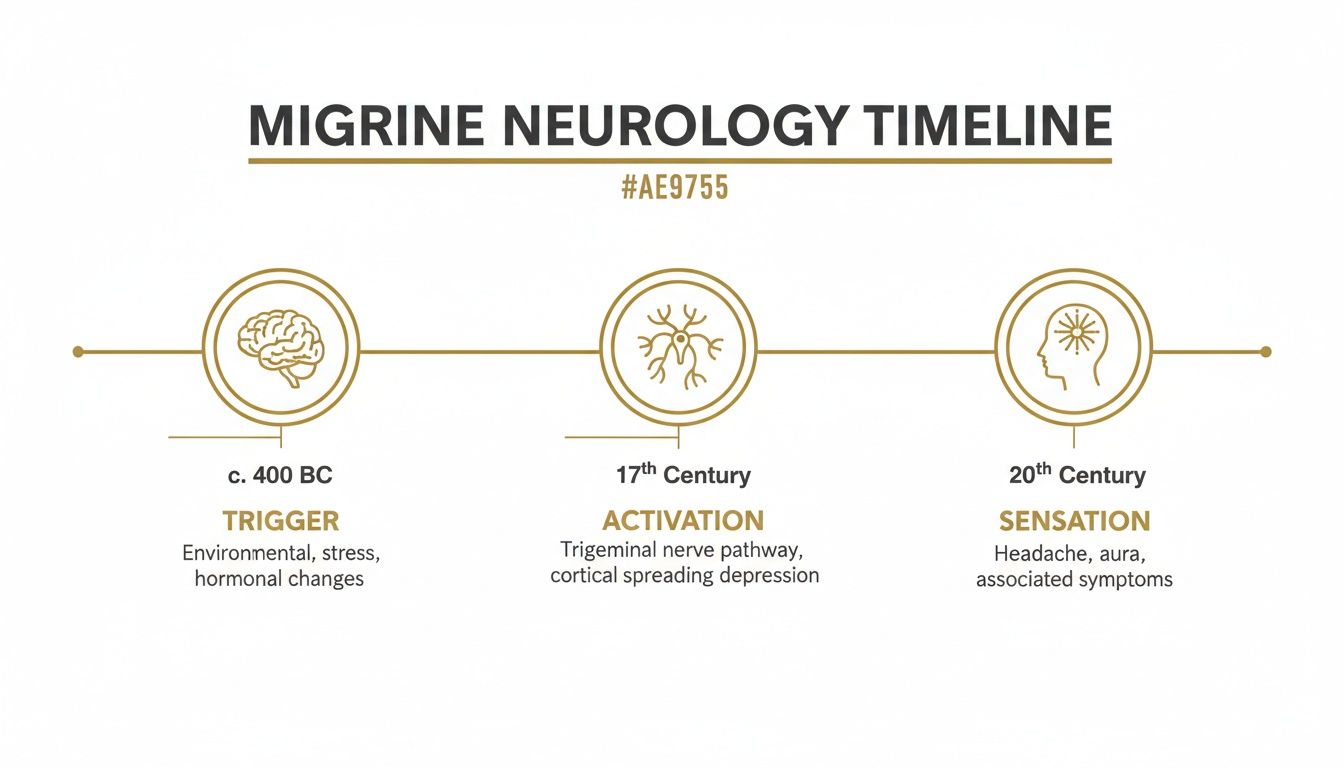
While auras can affect different senses, they are most commonly visual. Common experiences include:
- Visual Aura: Seeing flashing lights, shimmering zig-zag lines, geometric shapes, or developing temporary blind spots.
- Sensory Aura: A pins-and-needles sensation or numbness that often starts in the hand and moves up the arm to the face.
- Speech Aura: Difficulty speaking or finding the right words (transient aphasia).
The Headache Phase: The Main Attack
This is the phase most people associate with migraine. The headache itself can last from four hours to a gruelling 72 hours if left untreated. The pain is typically moderate to severe, often described as a throbbing or pulsing sensation, usually on one side of the head.
Simple physical activity, like walking upstairs, can significantly worsen the pain. The headache is often accompanied by other debilitating symptoms, such as extreme sensitivity to light (photophobia), sound (phonophobia), nausea, and sometimes vomiting.
The Postdrome Phase: The Migraine Hangover
When the intense pain finally subsides, the migraine attack is not necessarily over. The postdrome is a final phase that can linger for another 24 to 48 hours, often referred to as the "migraine hangover."
During this recovery period, you might feel completely drained, mentally foggy, or have trouble concentrating. Some people remain sensitive to light and sound, while others report feeling unusually refreshed. Your brain is essentially resetting itself back to its normal state.
To help visualise how these stages connect, here is a summary of the migraine journey.
Understanding the Four Phases of a Migraine
| Phase | Typical Onset | Common Symptoms |
|---|---|---|
| Prodrome | 24–48 hours before the headache | Mood changes, fatigue, yawning, food cravings, neck stiffness |
| Aura | 5–60 minutes before the headache | Visual disturbances (lights, zig-zags), numbness, speech difficulty |
| Headache | Lasts 4–72 hours | Throbbing pain (often one-sided), nausea, sensitivity to light & sound |
| Postdrome | 24–48 hours after the headache | Exhaustion, "brain fog," feeling drained, or sometimes euphoria |
This is a general guide. Your migraine experience is unique, and you may not have every symptom or phase. The key is to listen to your body and learn its patterns.
How Triggers and Thresholds Work Together

If you live with migraine, you have likely spent a lot of time trying to identify the one thing that sets off an attack. This search for a single "trigger" is understandable but can also be a frustrating exercise.
In clinical practice, a more helpful concept is the migraine threshold. This shift in perspective moves away from an endless search for culprits and toward strengthening your brain's resilience.
Think of your personal migraine threshold as a bucket. As long as there is space in the bucket, you remain below the threshold for an attack. When it overflows, an attack can begin.
The Bucket Analogy Explained
Throughout the day, various factors act like drops of water slowly filling this bucket. On their own, most of these "drops" are not enough to cause a problem. It is the cumulative effect that matters.
For example, a poor night’s sleep adds some water. Skipping breakfast and becoming dehydrated adds more. A stressful meeting at work tops it up further. Individually, any one of these might have been manageable. Together, they can push the water level to the brim.
This explains why a glass of red wine might be fine one night but seems to "trigger" an attack the next. The wine was not the sole cause; it was simply the final drop that caused an already full bucket to overflow.
Common Factors That Fill the Bucket
This way of thinking allows you to shift from a mindset of avoidance to one of proactive management. Instead of trying to dodge a long list of potential triggers, the goal is to keep the baseline level in your bucket as low as possible.
Common factors often fall into a few key categories:
- Physiological Stressors: Dehydration, poor sleep (or too much), and skipped meals.
- Environmental Factors: Bright or flickering lights, strong smells, and significant weather changes.
- Emotional Stress: A period of high anxiety, pressure at work or home, or a major emotional event.
- Hormonal Changes: For many women, the natural fluctuations of the menstrual cycle are a significant contributor.
The threshold concept is empowering because it puts the focus on what you can control. You cannot stop a storm from rolling in, but you can ensure you are well-hydrated and have had adequate sleep, giving you more capacity to handle factors you cannot change.
Managing Your Threshold Instead of Chasing Triggers
This approach leads naturally to focusing on foundational health habits that help keep your nervous system calm. Consistency is key. A regular sleep schedule, predictable mealtimes, and simple stress management techniques can lower the starting water level in your bucket each morning.
Of course, understanding personal factors is still important. For some, issues like persistent jaw clenching can be a significant contributor. In these cases, exploring options like Botox for Jaw Clenching and Relief may be a helpful part of a wider strategy.
Diet also plays a role, often as a contributor rather than a direct trigger. Learning to eat in a way that supports neurological health is a key skill. For those interested, you can learn how to control your migraines with the right diet in our dedicated guide.
By shifting your focus from triggers to your threshold, you move from a reactive state of avoidance to a proactive one of building resilience and feeling more in control.
How Migraine Is Diagnosed and Treated in the UK
Receiving a correct diagnosis is the first step toward managing migraine effectively. The diagnostic process is not typically about scans or tests; it relies on a detailed conversation with a healthcare professional.
A clinician will ask about your medical history and the specific character of your headaches. There is no blood test or single brain scan that can confirm a migraine diagnosis. Instead, the diagnosis is based on the pattern your symptoms reveal.
The Diagnostic Conversation
Your GP or a specialist will ask questions to build a clear picture of your experience. They will want to know about the pain—its location and quality—and any associated symptoms like nausea or sensitivity to light and sound.
Establishing a pattern is a crucial part of the puzzle. This is where keeping a headache diary becomes so valuable. It provides your doctor with a timeline, showing the frequency, duration, and severity of your attacks, which helps them match your experience to established clinical criteria.
They will be working to determine which type of migraine you have. The two most common are:
- Migraine without aura: This is the most common form, defined by headache attacks that fit a specific profile for duration, pain type, and accompanying symptoms.
- Migraine with aura: This includes the same headache features but is preceded or accompanied by temporary sensory disturbances, such as seeing flashing lights or experiencing numbness.
Navigating the UK Healthcare System
It is important to be realistic about the current pressures on the NHS. The UK is facing significant challenges in specialist migraine care, with waiting times for referrals having increased substantially since 2021. There is also a shortage of GPs with specialised training in headache management.
Despite these hurdles, your GP is the correct starting point for diagnosis and initial treatment.
An Overview of Treatment Approaches
Once a migraine diagnosis is confirmed, the focus shifts to creating a management plan. In the UK, treatments are generally grouped into two categories, and your plan will be tailored to your specific needs.
In clinical practice, the goal is not just to stop an attack when it happens. It is about reducing the frequency and overall impact of migraine on your life, which usually requires a combination of strategies.
Let's look at the main types of treatment.
Acute Treatments To Stop an Attack
These are medications taken at the first sign of a migraine to stop it from escalating or to relieve its symptoms.
Common options include:
- Triptans: These are migraine-specific drugs (like sumatriptan) that work by calming overactive nerves and blood vessels in the brain. They are often the first-line treatment for moderate to severe attacks.
- NSAIDs (Non-Steroidal Anti-Inflammatory Drugs): Over-the-counter options like ibuprofen can be effective, especially for milder attacks caught early.
- Anti-sickness medications: These help manage the nausea and vomiting that can accompany a migraine attack.
Preventive Treatments To Reduce Attack Frequency
If your migraines are frequent (typically four or more days a month) or severely impact your life, your doctor may discuss preventive medication. These are taken daily, not just during an attack, to make attacks less common.
This category includes a wide range of options:
- Beta-blockers and Antidepressants: Some medications originally developed for other conditions, like high blood pressure or depression, have been found to be very effective in preventing migraine.
- CGRP Antagonists: This is a newer class of medication designed specifically to block CGRP, the key protein involved in migraine pain. These are typically offered when other preventive options have not been successful.
Your clinician will consider the frequency and severity of your attacks, as well as your overall health, before recommending a course of action. Successful plans often combine medical treatment with lifestyle adjustments. Some people also find procedural options helpful; you can read more about how Botox for migraines works in our detailed article.
Building Your Personal Migraine Management Plan

While medical treatments are a cornerstone of care, the daily habits you build are just as crucial for living well with migraine. Creating a personal management plan is about building a sustainable lifestyle that supports your neurological health.
The core idea is to create stability for a nervous system that is sensitive to change. By establishing predictable routines, you can often lower the baseline stress on your brain, giving you more resilience against factors you cannot control.
Core Lifestyle Foundations
Lifestyle management for migraine typically centres on a few key areas known to promote neurological stability. These habits are interconnected and work together to create a more resilient system.
-
Consistent Sleep: Aim for a regular sleep-wake cycle, even on weekends. An erratic schedule can disrupt the brain's internal clock, a factor that can lower the migraine threshold.
-
Regular, Gentle Exercise: Physical activity can improve blood flow and help regulate the nervous system. Gentle consistency is key. Activities like walking, swimming, or yoga are often good choices.
-
Hydration and Nutrition: Maintaining steady hydration and blood sugar levels throughout the day can make a significant difference. Some people find that small, regular meals are more stabilising than fewer, larger ones.
-
Practical Stress Management: Chronic stress can keep the nervous system in a state of high alert. Simple techniques like deep breathing or mindfulness can help calm this response.
The Value of a Migraine Diary
A detailed migraine diary is one of the most powerful tools available. Its purpose is not just to identify triggers, but to help you and your clinician see the bigger picture.
When you track symptoms, sleep patterns, meals, and stress levels, you begin to see connections over time. You might notice that attacks are more likely after two nights of poor sleep, rather than being linked to a specific food.
A well-kept diary transforms vague feelings into concrete data. It provides the information needed for a more productive conversation with your doctor and allows for targeted, effective adjustments to your daily life.
The personal and financial toll of migraine in the UK is significant. Recent data suggests that chronic migraine can impose lifetime costs of over £3.5 million on an individual, including lost productivity and the psychological burden of the condition. With NHS neurology services under strain, proactive self-management is essential. You can learn more about the disease's profound economic impact on wecovr.com.
Creating a Sustainable Plan
A successful management plan is one you can maintain. It is about making small, consistent changes rather than overhauling your entire life at once. Start by focusing on one or two areas, such as a consistent bedtime or adequate hydration.
This approach works alongside your medical treatment, creating a powerful, two-pronged strategy. It empowers you to take an active role in your care, turning daily choices into a form of neurological support.
For readers wanting a structured overview of this process, this is explored in more detail in our Migraine Guide.
Common Questions About Migraine Management
Dealing with migraine naturally brings up many questions. It can feel like a confusing and isolating experience, but clear answers are a step toward feeling more in control. Here are some of the most common questions, with straightforward explanations.
Will I Have Migraines for the Rest of My Life?
The answer is different for everyone. For many people, migraine is a long-term condition, but this does not mean it will always be as intense or frequent as it is now. The pattern of attacks often changes over a lifetime. For instance, some women find their migraines improve significantly after menopause.
The goal of management is not necessarily a "cure," but to reduce the condition's impact on your daily life. With effective preventive treatments and lifestyle adjustments, many people can significantly reduce attack frequency, sometimes experiencing long periods of remission.
Can a Specific Diet Cure My Migraine?
Currently, there is no single diet that has been proven to "cure" migraine. While nutrition is an important part of the picture, the role of specific food "triggers" can be overstated and is highly individual.
Instead of focusing on restrictive elimination diets, which can be stressful, it is often more helpful to focus on stability. Eating regular, balanced meals to keep your blood sugar steady and staying well-hydrated are foundational habits that support brain stability.
In clinical practice, focusing on what to add—like regular meals and adequate water—often yields better results than focusing on what to take away. Building a resilient system tends to be more effective than avoiding a long list of potential food triggers.
Is It Safe to Exercise with Migraine?
Yes. In fact, regular, gentle exercise is often recommended for migraine management. It can be an excellent way to manage stress, improve sleep, and regulate the nervous system—all of which can help raise your migraine threshold.
The key is to find what works for you and to be consistent. Low-impact activities like walking, swimming, or yoga are often good starting points. Some people find that very sudden, intense exercise can act as a trigger, so it is wise to build up slowly and listen to your body.
Do I Need a Brain Scan to Be Diagnosed?
For most people, a brain scan like an MRI is not necessary to diagnose migraine. A diagnosis is typically made based on a thorough discussion of your symptoms, your medical history, and a standard neurological exam.
Scans are generally reserved for situations where symptoms are atypical or there are "red flags." This could include a sudden change in headache pattern or other neurological signs that suggest a different potential cause. In these cases, a scan is used to rule out other conditions, not to confirm migraine.
Here are brief answers to some other common questions about migraine.
| Question | Answer |
|---|---|
| How long does a migraine attack last? | Without treatment, a migraine attack can last anywhere from 4 to 72 hours. The main attack phase is often followed by a "postdrome" or hangover phase that can last another day or two. |
| Are my children likely to get migraines? | There is a strong genetic link. If one parent has migraine, a child has about a 50% chance of developing it. If both parents do, the risk rises to around 75%. |
| Is it just a bad headache? | No. Migraine is a complex neurological disorder. While a severe headache is a primary symptom, it also involves a wide range of other symptoms like nausea, light sensitivity, and cognitive changes. |
| Can I take my acute medication every day? | It is not recommended. Overusing acute medications (like triptans or painkillers) more than 10-15 days a month can lead to medication-overuse headache, which can worsen the condition. |
| When should I go to A&E? | You should seek urgent medical care if you experience the "worst headache of your life," a headache with a fever and stiff neck, or new neurological symptoms like weakness, numbness, or difficulty speaking. |
We hope these answers have helped to clarify some of the confusion you may be feeling. Gaining a clear understanding is a powerful step in managing a complex condition like migraine.
At The Patients Guide, we create structured resources to help you move beyond confusion and build a clear, actionable health plan. For those who want to go beyond articles and get a complete, step-by-step approach to understanding and managing your condition, explore our guides.
Also in Migraines


Finding Clear Help with Migraines: A Grounded Guide
Feeling overwhelmed? Get clear, evidence-based help with migraines. This guide explains how to manage symptoms, track triggers, and talk to your doctor.
Read More

Understanding Ocular Migraine Symptoms and Triggers
A clear, reassuring guide to understanding ocular migraine. Learn to identify symptoms, understand triggers, and know when to seek professional care.
Read More


Understanding Migraine Vestibular Vertigo
A clear guide to understanding migraine vestibular vertigo. Learn to recognize its symptoms, understand the causes, and explore effective management strategies.
Read More