





How to Prevent Tension Headaches: A Practical Guide

Searching for reliable advice on how to prevent tension headaches can be a frustrating experience. Many people find themselves navigating conflicting tips and quick fixes online, which often adds to the stress rather than relieving it.
This guide takes a different approach. There are no miracle cures here. Instead, we will walk through the way healthcare professionals tend to think about prevention. The focus is on understanding the patterns that can lead to that familiar feeling of a tight band around your head, rather than just reacting to the pain.
Understanding Tension Headaches Before You Act
An important first step in preventing tension headaches is to understand how they typically develop. They rarely appear without a reason. A tension headache can be seen as a final signal from the body after a gradual build-up of smaller stressors.
In clinical settings, tension headaches are often understood as the result of a few key factors accumulating over time.
From Confusion to Clarity
Most tension headaches tend to stem from a combination of these three areas:
- Muscular Strain: This is a primary factor. Persistent tension in the muscles of the neck, shoulders, and scalp is a common cause. This often results from posture-related habits, like slouching at a desk or looking down at a phone for extended periods.
- The Body's Stress Response: When you experience stress, your body can respond by physically tensing up. When that stress becomes chronic, the constant muscle contraction may contribute to headaches.
- Everyday Lifestyle Habits: Seemingly small habits can lower your threshold for developing a headache. Factors like inadequate hydration, skipping meals, or poor-quality sleep can make your body more vulnerable to other triggers.
Recognising that a tension headache is often the end result of these combined factors is a crucial part of prevention. It shifts the focus from finding a single solution to managing the overall build-up of triggers.
By understanding these connections, you can move from feeling confused by your symptoms to having a clearer path forward. This foundation is key to making the practical steps that follow more effective.
Improving Posture and Workspace Ergonomics
Many tension headaches don't actually start in the head. They often begin as persistent, low-grade tension in the muscles of your neck, shoulders, and upper back. In a world dominated by screens, it's common to spend hours with your head pushed forward, which can force these muscles into a state of overwork.
This forward-head posture creates direct mechanical strain. For every inch your head drifts forward, the effective weight your neck has to support can increase significantly. This is a major physical trigger for tension headaches, yet it often goes unnoticed until pain develops.
Fortunately, small, conscious adjustments to your daily posture and workspace can make a significant difference. The goal is to create an environment that supports a neutral spine, reducing the load on overstressed neck and shoulder muscles.
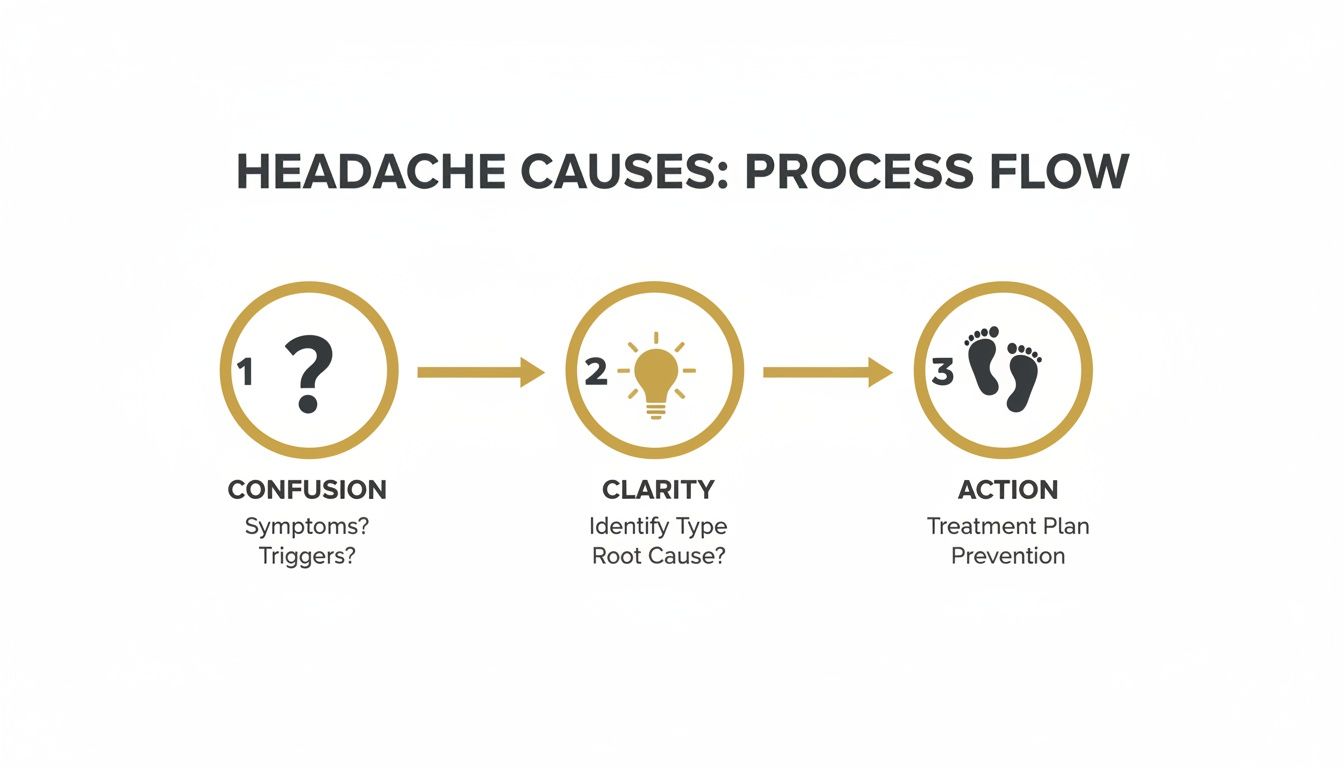
This journey from confusion to clarity is key. Once you understand the root causes, you can start making targeted changes that actually work.
Foundational Ergonomic Adjustments
You don't necessarily need expensive equipment to improve your workspace. It’s often about working with what you already have.
A few basic adjustments to your desk setup can dramatically reduce the physical stress that contributes to tension headaches. This table breaks down some of the most critical adjustments.
Simple Ergonomic Adjustments for Headache Prevention
| Workspace Element | Optimal Position | Why It Helps |
|---|---|---|
| Computer Monitor | Top third of the screen is at your direct eye level. | Prevents you from tilting your head down, which strains the back of your neck. |
| Chair/Back Support | Support the natural curve of your lower back (lumbar spine). | A stable base for your spine reduces strain all the way up to your neck and shoulders. |
| Feet Position | Flat on the floor (or a footrest) with knees at a 90-degree angle. | Stabilises your pelvis, which is the foundation for your entire spinal posture. |
These adjustments are not just about comfort; they are a core part of a preventative strategy.
Incorporating Movement and Stretches
Even a perfectly ergonomic setup has a limitation: it can encourage stillness. Holding any single position for too long can lead to muscle stiffness and tension. Regular movement is an effective countermeasure.
The approach is often "frequent, small movements" rather than one long break. Consider setting a reminder to stand up, stretch, or walk around for a couple of minutes each hour.
Simple stretches performed at your desk can also be beneficial. Gently tilting your ear towards your shoulder or performing slow chin tucks can help release tight muscles at the base of your skull—a common area for tension headache pain.
For a more structured routine, you might explore specific exercises for neck pain relief that directly target these problem areas.
By building these small, consistent habits, you can begin to dismantle one of the most common physical triggers for tension headaches before it has a chance to escalate.
Managing Stress and The Mind-Body Connection
The advice to "manage your stress" can sometimes feel vague, but for tension headaches, it is highly relevant. The connection between mental state and physical symptoms is a direct one. When under mental or emotional strain, the body often responds by tensing muscles in the jaw, neck, and shoulders – common sites for this type of headache.
This is a physiological response. The challenge with modern stress is that it is often chronic rather than acute. Muscles can end up in a state of prolonged, low-grade contraction, and that sustained tension may eventually manifest as a headache.
Understanding this link is a key step in breaking the cycle. The goal isn't to eliminate all stress, but to learn how to manage the body's physical reaction to it.

Interrupting the Stress Cycle with Mindful Breathing
One of the most direct ways to signal relaxation to your body is through controlled breathing. It can act as a manual override for the nervous system, helping it shift from a "fight or flight" state to a calmer one. As this shift occurs, tense muscles often receive the signal to relax.
Here is a straightforward, five-minute breathing exercise that can be done almost anywhere.
- Find a comfortable position, sitting upright or lying down.
- Gently close your eyes and take a moment to notice how your body feels.
- Breathe in slowly through your nose for a count of four, allowing your belly to expand.
- Hold the breath for a count of four.
- Breathe out slowly through your mouth for a count of six, feeling your shoulders drop.
- Repeat this cycle for five minutes, focusing on the rhythm of your breath.
While it may seem like a small action, its cumulative effect can be significant. This practice helps train the body to release tension proactively.
In clinical settings, mindfulness and relaxation techniques are often recommended as they have been shown to reduce tension headache frequency. Daily practices like guided breathing can create a buffer against everyday stressors.
Beyond Breathing: Foundational Relaxation Techniques
While breathing is a useful tool for in-the-moment situations, other practices can help build long-term resilience to stress-induced tension. One well-regarded method is progressive muscle relaxation. This involves systematically tensing and then fully releasing different muscle groups.
By consciously tensing a muscle for a few seconds and then letting it go, you can become more aware of where you hold tension. It also teaches you what deep relaxation feels like, which can make it easier to notice and release subconscious tension during the day.
For readers interested in exploring a wider range of non-medicinal approaches, our article on natural remedies for tension headaches examines this and other techniques. Developing a small toolkit of these practices can provide a greater sense of control over your body's response to stress.
The Foundational Role of Hydration, Nutrition, and Sleep
While factors like stress and posture are significant, simple daily habits form the foundation of our resilience against tension headaches. What you drink, what you eat, and how well you sleep all contribute to your body’s ability to cope.
Even mild dehydration can cause brain tissue to temporarily contract, which can be a direct trigger for headache pain. This serves as a reminder of how much our internal environment can affect how we feel.
Building Consistent, Body-Friendly Habits
The goal is consistency rather than perfection. When your body has a steady supply of fluids, stable energy, and adequate rest, it is generally less likely to signal distress in the form of a headache.
- Smart Hydration: Aim for a steady intake of water throughout the day. Keeping a reusable water bottle visible can serve as a helpful reminder.
- Don’t Skip Meals: Skipping meals, especially breakfast, can cause blood sugar levels to drop, which is a classic headache trigger for some individuals. Eating balanced meals and snacks at regular intervals helps maintain stable energy levels.
Research has shown that adequate hydration may reduce the frequency and severity of tension headaches. Similarly, skipping meals is a known risk factor. For those interested in the data, you can explore the study findings on headache triggers.

Why Sleep Is a Key Factor
Sleep is the body’s primary time for repair. It is when tense muscles in the neck, shoulders, and scalp can relax and recover. Insufficient or poor-quality sleep means you may start the next day already at a disadvantage.
Healthcare professionals often see a pattern: a poor night’s sleep is frequently followed by a day of nagging headaches. Lack of rest can lower the pain threshold and prevent muscles from fully releasing tension.
Creating an environment conducive to rest is important. This often involves a consistent bedtime, avoiding screens for at least an hour before sleep, and ensuring your bedroom is cool, dark, and quiet.
These three pillars—hydration, nutrition, and sleep—are powerful components of a tension headache prevention strategy. For more on how diet can support overall health, you can review the principles of good nutrition.
Medication, Tracking, and Getting to the Root Cause
While lifestyle changes are the most effective long-term strategy, there are times when relief is needed. For an occasional tension headache, over-the-counter (OTC) painkillers like paracetamol or ibuprofen can be appropriate.
The keyword is occasional. Relying on them too frequently can lead to a condition known as a medication-overuse headache. In this situation, the medication itself begins to cause rebound headaches, creating a cycle that can be difficult to break. It is generally advisable to use OTC medication as a rescue tool, not a primary prevention strategy.
The Power of a Headache Diary
To get ahead of the pain, it can be helpful to become a detective of your own patterns. One of the most effective tools for this is a simple headache diary. It helps you move from guessing your triggers to seeing clear patterns on paper.
A diary does not need to be complicated. A notebook or a notes app is sufficient. The goal is to collect information so that you (and your doctor, if necessary) can connect the dots.
Tracking is not about finding a single cause. It’s about spotting the subtle combination of factors—such as a poor night's sleep, a stressful day, and a missed meal—that might collectively contribute to a headache.
This simple act of observation can be very empowering, providing you with real information to build an effective plan.
What to Track for a Clearer Picture
For a diary to be useful, consistency is more important than complexity. Each time a headache occurs, try to note a few key details. After several weeks, a clearer picture is likely to emerge.
Consider noting the following:
- When did it start? The day and approximate time.
- How long did it last?
- How severe was it? A simple 1-10 pain scale is effective.
- What was happening that day? Note your stress levels, what you ate, the quality of your sleep the night before, and your activities.
- Did you take any medication? Log any medication and whether it helped.
This log can be invaluable. For readers who prefer a structured approach, our Tension Headache Guide includes templates designed to make this process simple. Understanding your personal triggers is the foundation for building a lifestyle that minimizes headaches.
Putting It All Together: Your Personal Prevention Plan
Lasting relief from tension headaches is rarely about making a sudden, drastic lifestyle change. That approach can be overwhelming. Instead, it is about making small, consistent adjustments that build on one another over time.
This guide was designed to explain the 'why' behind the 'what'. When you understand how daily habits connect to your headache patterns, you are better equipped to take control.
From Knowledge to Action
The key to progress is to start small. Choose just one area to focus on. Trying to overhaul your posture, sleep, diet, and stress management all at once is rarely sustainable. The goal is to build momentum with one positive habit at a time.
It is also important to remember that this information is designed to work alongside professional medical advice, not replace it. If your headaches are worsening, becoming more frequent, or significantly impacting your life, please consult your GP for a proper diagnosis and to rule out other causes.
Clarity is the first step toward control. The next step is to choose one single area we’ve discussed—perhaps it's drinking more water or trying a five-minute breathing exercise—and focus only on that for the next week.
For a More Structured Approach
Articles like this are useful for understanding the fundamentals. However, for those looking for a more structured, comprehensive roadmap that ties all these concepts together, a dedicated guide may be a logical next step.
For readers wanting to go beyond the basics to build a personalised plan, our Tension Headache Guide was created to offer that deeper level of support. It is designed to help you connect the dots between these different elements to make informed decisions for your health.
Your Questions Answered
How Long Until I See Results from These Changes?
There is no single timeline, as it varies for each individual. Some people may notice a difference within a few weeks, particularly if their headaches are linked to straightforward factors like dehydration or workspace ergonomics.
For triggers rooted in chronic stress or long-standing habits, it may take longer. Learning relaxation techniques is a skill that develops over time. The key is to be patient and consistent. A headache diary can be very helpful here, as it allows you to see gradual improvements you might otherwise miss.
Could My Diet Be Causing My Tension Headaches?
While certain foods are more commonly associated with migraines, they can still play a role in tension headaches for some people. Common triggers can include excessive caffeine (or caffeine withdrawal), alcohol, and processed foods containing nitrates, such as cured meats.
The most effective way to determine if there's a connection for you is to keep a detailed food and headache diary for a few weeks. You may begin to notice a pattern, such as a headache developing after consuming a specific food or drink.
When Is It Time to See a Doctor?
You should consult your GP if you notice any significant change in your headaches. This could include them becoming more frequent, more severe, or not responding to your usual pain relief methods.
Additionally, certain "red flag" symptoms warrant immediate medical advice. If a headache is accompanied by a fever, stiff neck, confusion, vision problems, or weakness, it is crucial to seek a medical opinion promptly. A doctor can provide a proper diagnosis, rule out more serious conditions, and discuss further treatment options if needed.
If you're ready to create a structured, comprehensive plan to get ahead of your headaches, The Patients Guide offers a step-by-step approach to understanding and managing your health. Explore all our guides to take the next step.
Also in Tension Headaches

8 Natural Remedies for Tension Headaches
Struggling with tension headaches? Explore 8 evidence-informed natural remedies for tension headaches, from stretches to stress management.
Read More